Hello There!
I am a postdoctoral researcher in the fundamental physics research group at the Max-Planck institute for Radio astronomy in Bonn, Germany. My interests and research focus on radio interferometry, mainly using MeerKAT, galactic and extragalactic radio continuum science, and large scale cosmology.
On this page you can find more information about my research interests, a short CV and my contact information.
Research
All my publications can be found at this ADS link. My first author, refereed publications can be found at this link. I will highlight my main research interests here, you can read more about previous research projects on my 'other projects' page.
Testing large scale cosmology with radio catalogues
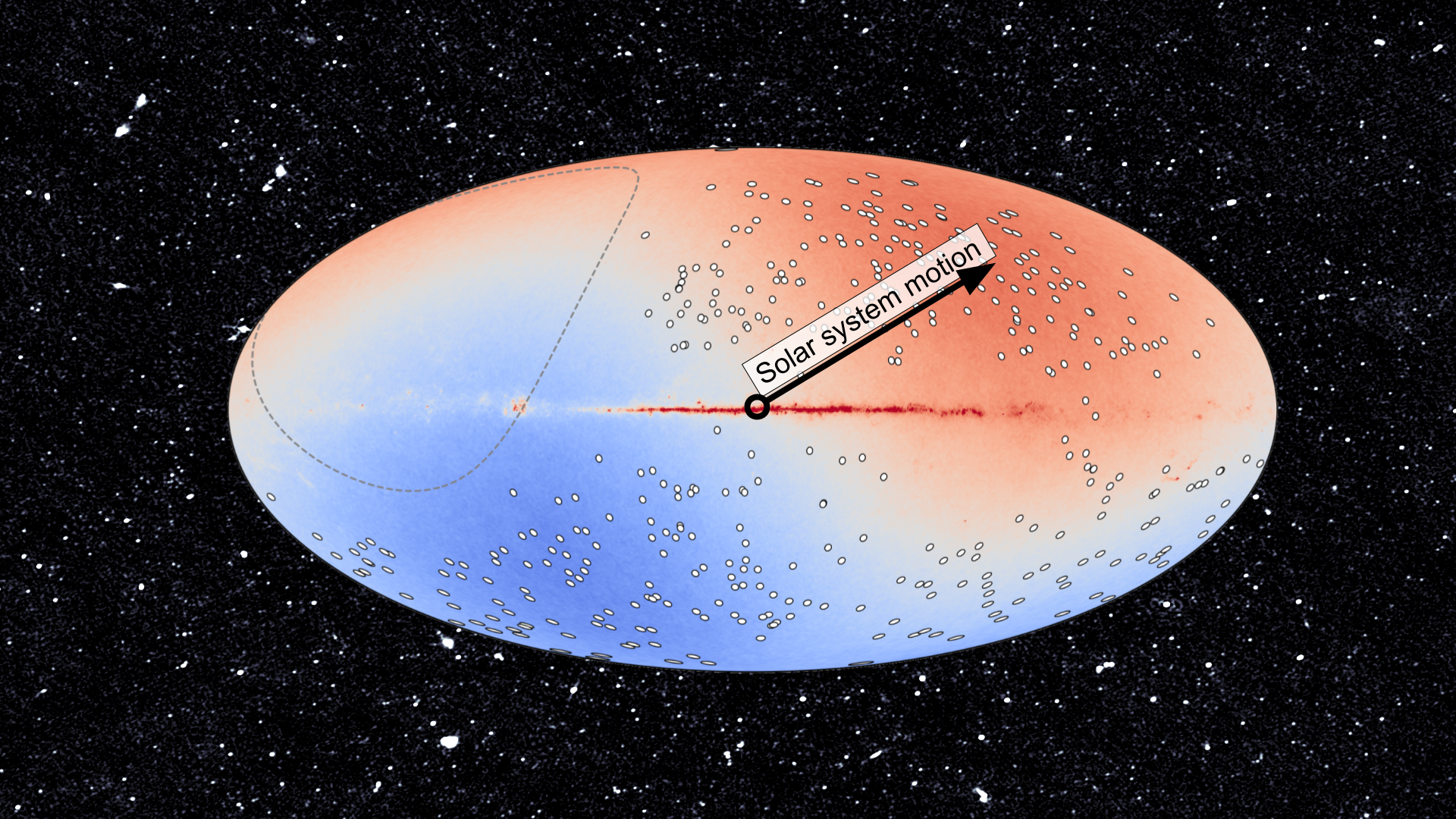
Fundamental to our modern description of cosmology are the assumptions of homogeneity (no special place) and isotropy (no special direction) of the Universe at large scales. The largest anisotropy we can see on the sky is a dipole measured from the cosmic microwave background (CMB), mostly assumed to be caused by the motion of the Solar system through the Universe. Several studies show a discrepancy between the dipole measured from the CMB and the dipole measured from observations of radio sources, presenting an intriguing puzzle as to what causes this discrepancy. Thus far, surveys have struggled to be sensitive enough to convincingly measure this dipole, and many seen and unseen systematic effects might skew the results one way or the other. Through the use of advanced estimators and new data I aim to measure the dipole more precisely than before, and perhaps find out where the excess signal is coming from. This has so far led to the most significant detection of the excess dipole with radio catalogues thus far, as well as a measurement of the radio with MeerKAT data.
The MeerKAT Absorption Line Survey
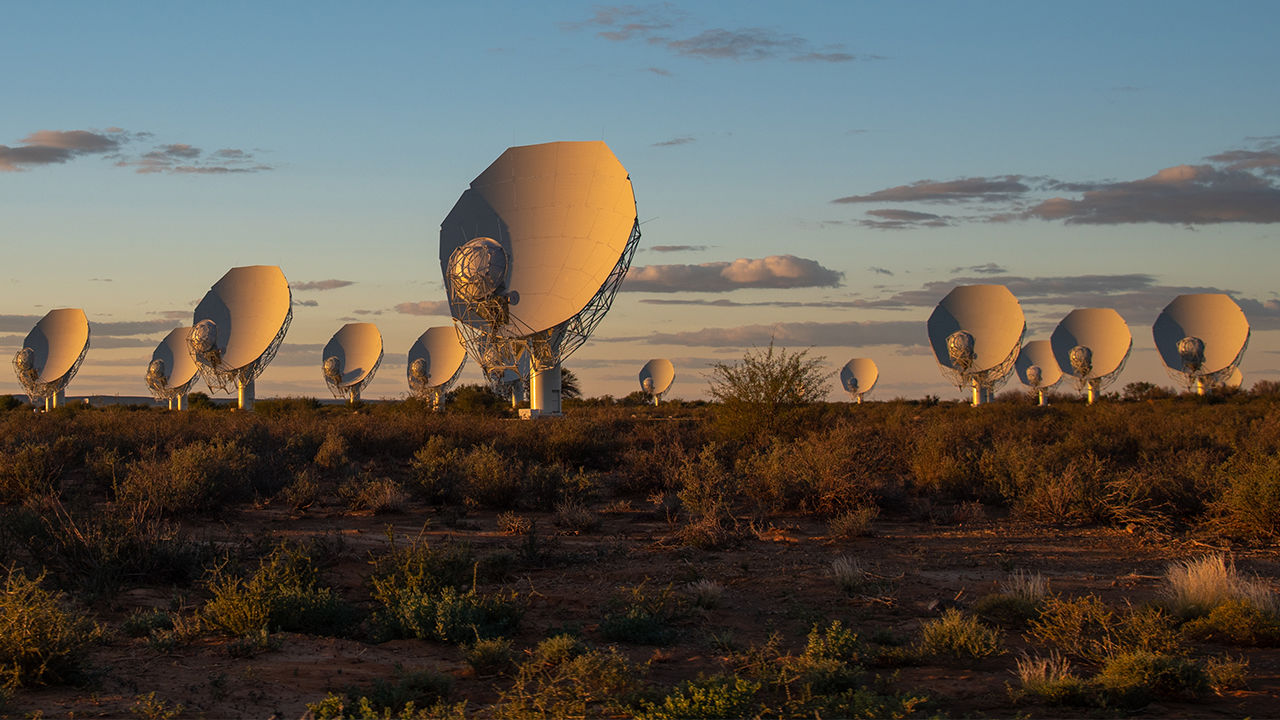
As part of my PhD I worked with continuum data from the MeerKAT Absorption Line Survey (MALS). While the primary focus of the survey is to look at absorption lines in the spectra of the target sources, due to the sensitivity and large field of view of the telescope each observed field contains thousands of sources. The current continuum data release (MALS DR2) consists of 391 fields and contains nearly a million sources, presenting an enormous dataset that is neatly distributed across the sky. My work was largely focused on processing of continuum data and creating these catalogues. While my main goal with MALS was to measure the cosmic radio dipole, as co-chair of the continuum science and polarisation science working group of MALS, I am always looking for more ways to utilise the amazing data we have.
Short CV
Below you can find a short version of my CV, a longer version can be found here
Professional experience
Sep. 2024 - Postdoctoral researcher Max Plank Institute for Radio Astronomy, Germany
Nov. 2019 - Aug. 2024 PhD researcher Max Plank Institute for Radio Astronomy, Germany
Education
Nov. 2019 - Aug. 2024 PhD Astronomy Max Plank Institute for Radio Astronomy, Germany
Sep. 2017 - Aug. 2019 MSc Astronomy & Research Leiden University, The Netherlands
Sep. 2014 - Aug. 2017 BSc Astronomy Leiden University, The Netherlands
Successful observing proposals and observing experience
- Isaac Newton Telescope, PI, 10 nights visitor mode
- Telescopio Nazionale Galileo, Co-I, 4 hours service mode
Contact Me
Here is where you can find me both physically and online.
Office Address
Max Planck Institut für Radioastronomie
Auf dem Hügel 69, 53121 Bonn, Germany
Email and phone
Email: wagenveld [at] mpifr-bonn [dot] mpg [dot] de
Phone: +49 (0)228-525-530
If you'd like to get in touch, feel free to send me an email on the address listed above!